A business loan is borrowed money a company agrees to repay over time with interest and fees. Lenders — banks, credit unions, online lenders, and alternative firms — evaluate an application and financial documents to set rates, terms, and the repayment schedule.
Funds arrive as a one-time lump sum or as a flexible line of credit. That choice affects how the amount is used and when repayments begin. Missing scheduled payments can lead to late fees, default, and the loss of pledged collateral or a personal guarantee.
The guide previews common structures like term loans, lines of credit, merchant cash advances, and invoice financing. It also shows how lenders assess risk through revenue, credit, and collateral, so a company can pick the right product and plan for repayment.
Key Takeaways
- A business loan provides short- or long-term financing that must be repaid with interest.
- Lenders use an application and documents to set pricing, rates, and terms.
- Funds come as a lump sum or a credit line, and repayment follows a schedule.
- Default can trigger collateral seizure or enforcement of guarantees.
- The guide compares common products and helps plan responsible borrowing.
What a Business Loan Is and Why It Matters for U.S. Businesses Today
A loan provides targeted financing that matches a firm’s immediate needs and growth plans. It can fund equipment, inventory, payroll, marketing, or an acquisition. Lenders often ask about intended use and expected returns.
Access to capital matters because many firms face uneven cash flow and seasonal swings. With proper funding, a company can meet payroll, buy inventory, or invest in expansion without pausing operations.
Lenders review both business credit and personal credit, plus cash flow, existing debt, and time in operation. Banks typically expect two years; some online lenders accept six months.
- Common uses: working capital, commercial improvements, or buying equipment.
- Documentation: tax returns, P&L, balance sheets, and bank statements during application.
- Benefit: larger amounts, longer terms, and generally lower pricing than consumer options.
| Use | Typical term | Common credit checks |
|---|---|---|
| Equipment financing | 3–7 years | business credit, personal credit |
| Working capital | 1–5 years | cash flow, credit score |
| Commercial property | 5–20 years | time in business, financials |
how do business loans work: a simple step-by-step

Following simple steps reduces surprises during the application and funding phases. This short guide maps the sequence from planning to repayment so owners can spot costs, timing, and risk.
Pre-application: define use of funds and repayment plan
Start by naming the purpose and the expected deployment time. Build a brief cash forecast that shows how the firm will pay back principal and interest.
Application: documents, credit checks, and underwriting
Submit a clear loan application with tax returns, P&L, balance sheets, bank statements, and a debt schedule. Lenders check business and personal credit and verify revenue.
Approval and funding: lump sum vs. line of credit
Approval sets amount, term, pricing, and any fees. A lump-sum term loan delivers capital up front. A line credit lets an owner draw and reuse available funds.
Repayment and what happens if you default
Repayment follows the agreed schedule — monthly amortization or more frequent remits for some products. Missing payments can trigger late fees, higher interest, acceleration, and seizure of pledged collateral.
- Plan use and pay-back timeline before applying.
- Gather documents to speed the application process.
- Ask lenders about collateral, personal guarantees, and fees.
Business Term Loans Made Simple

A term loan delivers a fixed sum up front with a set repayment schedule that matches a project’s timeline. This form of financing gives an owner predictable monthly payments and a clear payoff date. Traditional banks often provide lower interest rates but require stronger credit and more paperwork.
Lump-sum funding, fixed schedules, and typical loan terms
Term loans are disbursed as one amount and repaid on a fixed timetable, usually with monthly principal and interest. Underwriting sets the approved amount and interest rate based on credit, collateral, and debt service coverage.
Best uses: growth, equipment financing, and commercial real estate
These loans suit multi-year investments that match an asset’s useful life. Owners use them for expansion, buying equipment, or acquiring real estate so cash flow is preserved.
- Predictability: clearer amortization than revolving credit.
- Match terms: align loan term with asset life to avoid short-term strain.
- Compare offers: check origination fees, covenants, and prepayment rules.
| Use | Typical years | Common focus |
|---|---|---|
| Equipment | 3–7 | Vendor quotes, useful life |
| Expansion | 1–5 | Cash flow plan |
| Commercial real estate | 5–20 | Collateral and term match |
Business Lines of Credit for Cash Flow Flexibility

A line credit gives a firm access to a reusable limit it can draw against and repay as needs change. Interest accrues only on the amount actually used, which keeps carrying costs low for intermittent needs.
How draws, limits, and revolving credit work
A lender sets a cap based on revenue trends, credit profile, and existing obligations. Draws reduce available capacity and repayments restore it. Payments may be weekly or monthly and usually reflect the drawn balance.
When a line beats a fixed-term loan
Lines suit uneven cash flow, seasonal inventory, and emergency purchases. They avoid paying interest on an entire approved amount, unlike a term loan that disburses a full principal.
- Costs to compare: interest rates, draw fees, annual fees, and inactivity charges.
- Qualification: online lenders may fund faster but at higher rates; banks tend to offer lower rates.
- Policy tip: set draw rules and repayment priorities to limit utilization and protect credit.
| Feature | Line of Credit | Term Loan |
|---|---|---|
| Interest basis | On drawn amount | On full principal |
| Best for | Cash flow gaps, inventory | Fixed purchases, expansion |
| Repayment | Revolving, interest-only options | Scheduled amortization |
| Fees | Draw, annual, inactivity | Origination, prepayment |
Merchant Cash Advances and Invoice Financing: Fast but Costly Options

Some quick-capital options trade speed for cost, giving owners near-instant funds but higher long-term expense. These products suit urgent gaps in cash flow, yet they change repayment dynamics and pricing compared with traditional credit.
Merchant cash advances
Merchant cash advances provide an upfront sum repaid via frequent debits or a percentage of daily sales. They fund operations fast and require minimal credit history.
Be aware: daily or weekly remittances shrink near-term cash and can strain margins. Factor rates and flat fees often translate to a much higher interest equivalent than term products.
Invoice financing
Invoice financing advances a portion of outstanding invoices. When customers pay, the advance plus fees is repaid, and the remaining amount is released to the firm.
This option treats unpaid invoices as collateral, easing approval even if traditional credit is weak. Still, fees and advance percentages reduce the net amount available for operations.
- Convert factor rates and flat fees to an APR to compare true cost.
- Looser credit checks make approval easier, but pricing is steeper.
- Avoid stacking advances; rolling balances can create a persistent debt cycle.
| Feature | Merchant Advance | Invoice Financing |
|---|---|---|
| Repayment cadence | Daily/weekly | Upon invoice payment |
| Typical cost view | High effective APR | Moderate to high fees |
| Collateral | Future sales | Accounts receivable |
Before accepting a fast offer, owners should model slow-sales scenarios, exhaust lower-cost lenders such as banks or CDFIs, and read contracts for renewal clauses, confessions of judgment, and aggressive collection terms.
Choosing Between Banks, Online Lenders, and Alternative Lenders
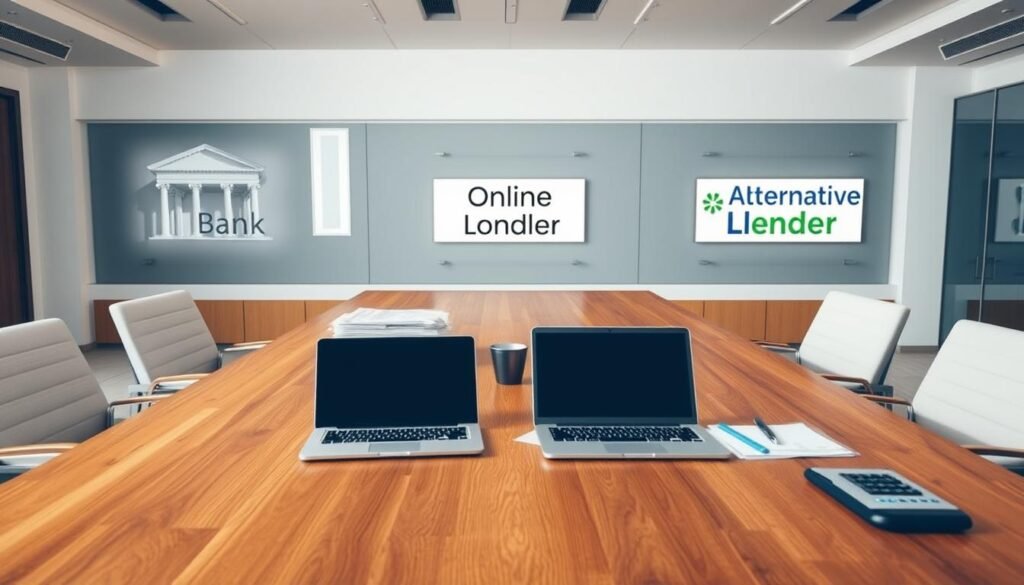
Choosing the right lender shapes costs, timing, and the long-term relationship an owner will have with capital providers. Each provider type fits different qualification strengths and urgency levels.
Banks and traditional lenders
Banks typically offer the lowest interest rates and long-term stability. They favor firms with solid financials, a strong credit score, and several years of operation.
The trade-off is a slower process and stricter documentation requirements.
Online lenders and fintech platforms
Online lenders speed funding and simplify applications. They often approve and send funds in days.
Borrowers should expect higher costs and shorter terms from these faster providers.
Alternative lenders and CDFIs
Alternative lenders include fintechs, merchant cash advance firms, and nonprofit CDFIs. CDFIs can offer competitive rates and mission-driven access.
Some alternatives specialize by industry or collateral type, which can improve approval odds for niche businesses.
- Match urgency and qualifications: pick speed or price based on need.
- Compare fees: origination, renewal, and ongoing charges affect true cost.
- Pre-qualify: preserve credit while estimating likely rates.
| Provider | Typical strength | Common products |
|---|---|---|
| Banks | Low rates, strict credit checks, longer time | Term loan, line credit, commercial real estate |
| Online lenders | Fast approval, higher rates, less paperwork | Short-term loans, lines credit, equipment financing |
| Alternative & CDFIs | Access for newer firms, varied terms, mission focus | Term loans, invoice financing, targeted programs |
Secured vs. Unsecured Business Loans and Key Loan Terms
A clear split exists between loans backed by assets and those granted on reputation and cash flow alone.
Secured loans require collateral such as real estate, machinery, cash accounts, or marketable investments. Pledging an asset can lower pricing and widen access for smaller firms with limited credit histories.
Collateral and guarantees
Unsecured options rely more on company strength, owner credit, and the lender relationship. Lenders may still ask for a personal guarantee that shifts liability to the owner if the firm cannot repay.
Key loan terms to watch
- Payment frequency and amortization style affect monthly cash needs.
- Rate type, prepayment rights, and default penalties set true cost and flexibility.
- Cross-default clauses can tie multiple obligations together.
| Feature | Secured | Unsecured |
|---|---|---|
| Typical collateral | real estate, equipment | personal credit, revenue |
| Pricing | Lower interest | Higher interest |
| Owner risk | Liens on assets | Personal guarantees |
Match collateral to the loan purpose and duration. Keep clear records of liens and UCC filings. Evaluate total exposure — secured plus guaranteed obligations — and seek carve-outs or cure periods where possible.
The Real Cost of Borrowing: Interest Rates, Fees, and APR
Quoted rates tell only part of the story; annualized costs reveal what the borrower actually pays. APR combines the nominal interest rate with upfront and ongoing charges so offers can be compared on an apples-to-apples basis.
Interest rate vs. APR: why the difference matters
The interest rate is the basic price on the principal. APR adds typical fees and spreads them over the term. That makes APR a clearer measure of the total cost and the true monthly impact.
Common fees to expect
- Origination and application fees charged at approval.
- Servicing or annual maintenance fees for ongoing accounts.
- Draw charges on a line credit and appraisal costs for secured loans.
Late payments and total repayment amount
Late payments lead to penalties, higher rates, and damaged personal and business credit. These add to the total amount repaid and can force acceleration or default.
| Element | Effect on Cost | What to check |
|---|---|---|
| Interest rate | Base borrowing cost | Fixed vs. variable |
| APR | Annualized total cost | Includes fees and timing |
| Fees | Raise effective rates | Origination, draw, appraisal, annual |
Before signing, borrowers should calculate APR, model best- and worst-case repayment scenarios, confirm prepayment rules, and include legal or closing costs. Negotiating fee waivers or reduced charges can cut the effective rate and lower the final amount repaid to the lender.
How to Qualify for a Business Loan
Underwriters focus on measurable credit behavior and realistic cash forecasts to judge risk. Clear records and modest leverage raise the chance of approval. Applicants should prepare a concise set of documents before starting the application process.
Credit profile and scores
Underwriters review both business credit and the owner’s personal credit history. Payment history across trade lines and a solid credit score matter most.
Required financial documents
A complete loan application needs multiple years of tax returns, current P&L and balance sheets, and recent bank statements. Uploading organized digital files speeds review and reduces follow-up requests.
Time in operation and existing debt
Lenders consider time in business—banks often expect two years, while some online lenders accept six months. High existing debt can lower debt service coverage and hurt approval odds.
Collateral, guarantees, and improving odds
Pledging collateral or offering a personal guarantee can offset weaker credit and secure better pricing. Pre-qualification tools let applicants check likely ranges without multiple hard inquiries.
- Check business credit reports and correct errors before filing a loan application.
- Model cash forecasts that show payment coverage under slow-sales scenarios.
- Consider CDFIs or online lenders if operating history is short.
| Factor | Lender focus | What to provide |
|---|---|---|
| Credit score | Payment history, trade lines | Credit reports, dispute corrections |
| Cash flow | DSCR and bank balances | P&L, bank statements, cash forecast |
| Time & industry | Stability and volatility | Years in operation, tax returns |
| Collateral | Reduce risk, improve pricing | Asset appraisals, lien documentation |
Planning Use of Funds and Repayment Strategy
A clear funding plan links the loan amount to measurable returns and reduces surprise costs. Match the chosen product to the project’s life and the firm’s receipt timing before accepting an offer.
Match product to need
Short-term working capital often fits a revolving line or line credit. That keeps interest low by charging only on used funds.
Long-lived purchases such as equipment and real estate usually suit term financing with fixed schedules. This aligns payments to asset useful life and protects cash flow.
Budgeting, refinancing, and early payoff
Maintain a rolling 12-month cash flow budget that includes debt service and reserves. This shows when repayments hit and where gaps may appear.
Consider refinancing if rates fall or consolidating multiple obligations to cut cost and simplify administration. Review loan terms carefully: early payoff can save interest but may trigger penalties that offset benefit.
- Size the amount conservatively; avoid borrowing beyond need to limit carrying costs.
- Set KPIs linking funded projects to revenue, margin, or cost-savings goals.
- Plan contingencies: interest-only periods or timed drawdowns to match receivable collections.
- Coordinate equipment purchases with warranties, insurance, and maintenance budgets.
- Reforecast regularly and alert lenders when performance diverges to manage covenants proactively.
| Purpose | Best product | Typical years | Key checkpoint |
|---|---|---|---|
| Working capital | Line credit / revolving | 0–2 | Utilization & reserve level |
| Equipment | Term loan or equipment finance | 3–7 | Asset life, maintenance costs |
| Real estate | Commercial term or mortgage | 7–20 | Appraisal, amortization match |
Conclusion
Smart borrowing ties the amount and term to measurable returns and a clear repayment plan. Owners should match the type of financing — from term loan to a line or invoice advance — to the project duration and cash rhythm.
Compare APRs, fees, and covenants across lenders to see true cost. Prepare tidy financials and improve credit before applying to boost approval odds and pricing.
Weigh trade-offs: banks often offer lower rates but slower timelines; online and alternative lender options trade speed for higher cost. Reforecast performance, keep lenders informed, and document post-funding ROI.
Use capital to accelerate profitable growth, not to mask structural shortfalls. Disciplined repayment and periodic reviews help preserve future options and reduce risk.